
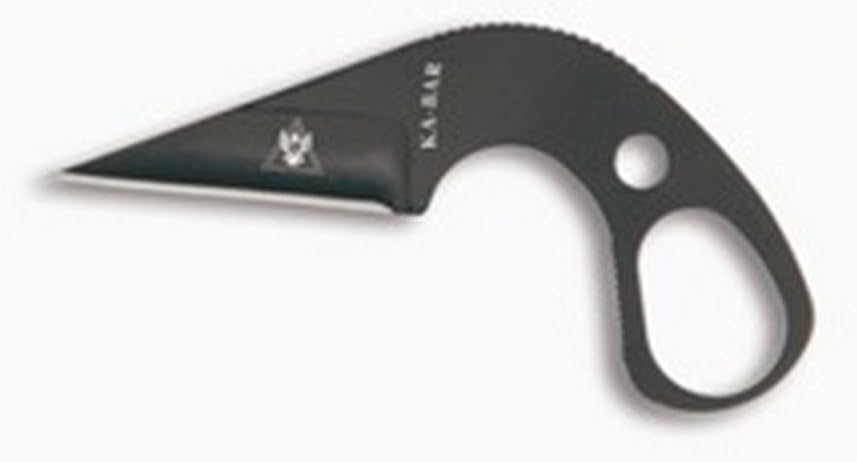
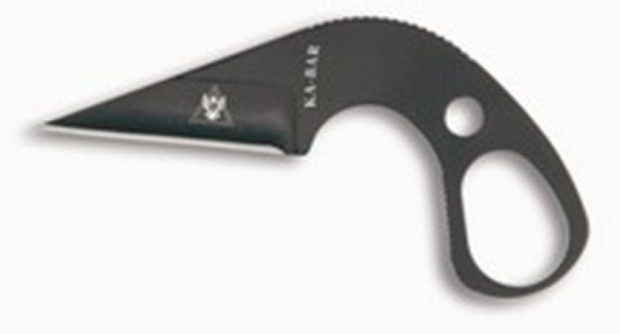
Some of my newer readers may not realize that I designed the Last Ditch Knife (LDK) for Ka-Bar knives. I first sketched it out 20 years ago and it has been in continuous production since then.
Last week Aimpoint released a podcast I recorded with Rich Nance where we talked a bit about the knife. I added a short video clip of our discussion below.
Last Ditch Knives and How To Escape in Danger
For those of you who don’t like video, here’s an explanation of my design.
I designed it primarily as a knife that could easily be missed on a cursory search if one was taken hostage. I had been traveling through South America a lot and was worried about kidnapping attempts. There just weren’t any really good knives on the market that could be easily hidden.
My initial thought was that I wanted something no larger than a credit card, so that I could carry it in a wallet if I wanted to. If I did that, it had to be exceptionally thin as well.
I wanted a blade design that would do a lot of damage for its small size. That’s why I designed it with the straight edge and very sharp point. It isn’t designed as a general purpose cutting tool. It’s designed to cut flesh like a bigger knife. It essentially duplicates a #11 scalpel blade, a tool expressly designed to cut flesh as efficiently as possible.
After I designed the knife, I wanted a sheath that could be hidden anywhere. I put multiple holes in it so that it can be laced in a boot or safety-pinned inside a piece of clothing. I originally carried mine safety pinned inside and below the rear waistband of my pants when I travel in third world countries. That way I could cut myself free if my hands were tied or taped behind my back. I also carry one in my wallet.
I have since modified the carry mechanism slightly by attaching a small keyring. I loop the keyring around my rear pants belt loop at the small of my back and tuck the knife down inside my waistband. I have also attached a small handcuff key and handcuff shim from OscarDelta to the same keyring. Now, no matter how I may be restrained, I have a reliable option for escape.
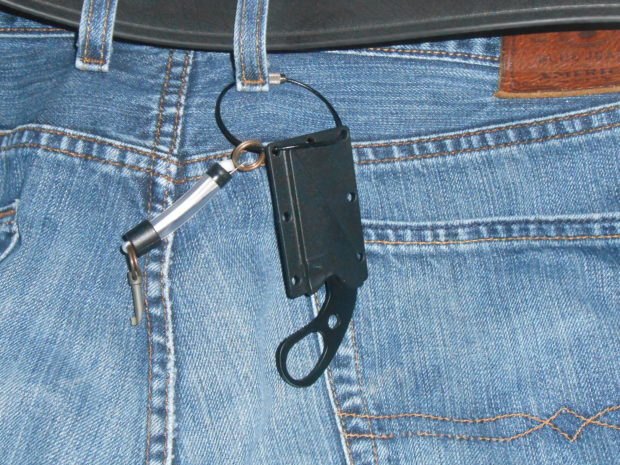
LDK knife attached to keyring and belt loop. The knife is then pushed inside the waistband of the pants and is easily missed on a casual search.
The hole in the handle is not designed for a finger. Many people try to grip it by curling a finger through the hole. It doesn’t work that well. I put the hole in the handle to save weight and provide an extra means to draw it. If the sheath is flat against a hard surface (like laced in a boot), it is difficult to get a full hand grip on the handle to draw. The hole allows you to catch a single finger inside to pull it from the sheath in order to transition to a better grip.
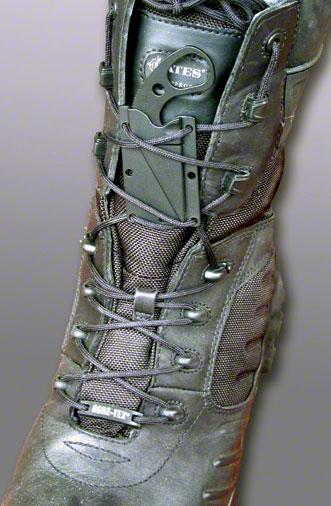
LDK knife laced into boot. The hole in the handle allows a one-finger draw when it is laced flat like this and a proper grip can’t be obtained.
The proper grip to hold the LDK for fighting purposes is very similar to the way one would hold the original Ka-Bar TDI Law Enforcement knife. It is held protruding from the fist so that it penetrates during a punch. See the photo below.
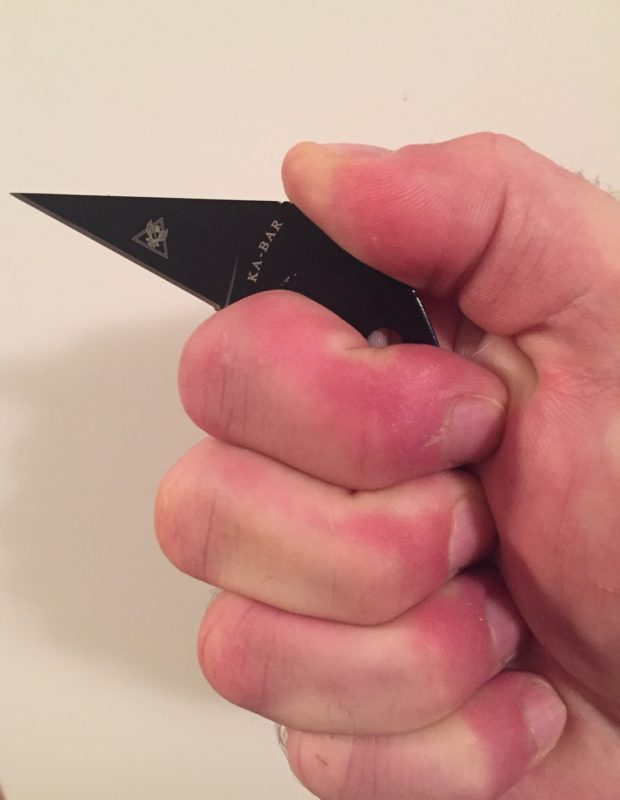
Proper grip on the LDK
The knife can be purchased wherever Ka-Bar knives or sold. It is also available on Amazon.com. This is the best $25 life insurance policy you can buy.
Some of the above links (from Amazon.com) are affiliate links. If you purchase these items, I get a small percentage of the sale at no extra cost to you.